As for interstellar travel, even the realists are far from giving up. All it takes is one breakthrough to make the calculations work, Frisbee said.
"It's always science fiction until someone goes out and does it," he said.
Tuesday, August 19, 2008
Rocket Scientists Say We'll Never Reach the Stars
Wired reports a depressing article, Rocket Scientists Say We'll Never Reach the Stars. The line that got me was "The calculations show that, even using the most theoretical of technologies, reaching the nearest star in a human lifetime is nearly impossible." It is very depressing to realize that after 50 years of space travel, even nearby stars aren't in our purview. Still, the last line brings hope.


Bigfoot BS
Information Week has an article, but please don't click on it. Bigfoot Hoax Called A 'Scheme To Defraud'. Of course it's a scheme to defraud! Bigfoot is NOT real. Either they are liars or they are idiots. The men who were contacting media outlets about the scam said they bought it from some men. Then they are the idiots and the sellers were frauds! There is NO SUCH THING AS BIGFOOT! Why is the media reporting this? I realize the hypocrisy of blogging about something I say the media shouldn't mention, but if everyone attacks the media every time they report this stuff, they will eventually stop. That, and by not reading there articles when the headlines are this insipid.
Monday, August 18, 2008
Real Politics
In politics today, I am often astonished by the inanity of questions asked by political reporters, both in interviews and in debates. Here is an excellent story about what Rick Warren could have asked Barack Obama and John McCain. I don't care who answers the questions better, I want them to be nuanced, difficult, and sophisticated.
What Rick Warren could have asked
What Rick Warren could have asked
Monday, August 4, 2008
Phil Plait, the new James Randi
Phil Plait is taking over as President of the James Randi Educational Foundation, or JREF. Let me start by saying that James "The Amazing" Randi is awesome. He is actually the subject of an Isaac Asimov Black Widower's story, known as "The Amazing Larri". The JREF is everything I stand for, better science and critical thinking education. Still, he is getting on in years, and this will allow him to finish working on a couple of books, as well as probably performing more magic, and possibly relaxing (though knowing him, that may not happen). Phil Plait is the Bad Astronomer. Now, you'd think James Randi could find a good astronomer to take over, but you have to take what you can get. Anyway, Phil Plait could be my long lost twin, we are so much alike in many ways, the major difference being that he is a big Doctor Who fan. This is exciting for science and skepticism. Hopefully this will mark the advent of a new age in reason.
Friday, July 25, 2008
Deep Geeking
A cool new website Deep Geeking has grown out of the cool old (internet years) Babylon Podcast. I've submitted my first deep geek, and it's very deep. It's about the new X-Files movies, titled I Don't Want to Believe, I want the Truth. Please leave any comments about the post on the Deep Geeking forum.
Saturday, July 19, 2008
Dr. Horrible's Sing-Along Blog
Dr. Horrible's Sing-Along Blog is a musical supervillian epic created by Joss Whedon, and starring Neil Patrick-Harris, Nathan Fillion, and Felicia Day. It is available for free until midnight on Sunday July 20, and for purchase after that. Having just viewed it for free, I have to say it would be worth purchasing. Joss is attempting to change how movies and shows are distributed, and this is an admirable attempt. I will purchase the DVD for the extras.
The show is a pretty standard plot for supervillian shows, the main supervillain (Harris) has a blog, where he talks about his villainy. There is lots of singing, helping the homeless, laundry, and other insanity. Of course, I predicted the ending about 27 seconds into the third chapter, but then by the end I'd forgotten about it! I laughed out loud quite a few times, and some of the lines are instant classics. "The Hammer is my ...", for one. The ending is classic Joss, building up to it and then stripping everything away for a quite ending. If you enjoyed "Once More With Feeling", then this may just make your year.
The show is a pretty standard plot for supervillian shows, the main supervillain (Harris) has a blog, where he talks about his villainy. There is lots of singing, helping the homeless, laundry, and other insanity. Of course, I predicted the ending about 27 seconds into the third chapter, but then by the end I'd forgotten about it! I laughed out loud quite a few times, and some of the lines are instant classics. "The Hammer is my ...", for one. The ending is classic Joss, building up to it and then stripping everything away for a quite ending. If you enjoyed "Once More With Feeling", then this may just make your year.
Sunday, May 25, 2008
Indiana Jones and the Kingdom of the Crystal Skull
I just watched the new Indiana Jones movie, and I have to say, going in I was pretty excited. I recently rewatched Last Crusade, which is not just my favorite Indiana Jones movie, it is one of my favorite movies. Like Star Trek VI, it transcended the level of the other films and was a classic. Alas, Crystal Skull was not such. The whole thing with the groundhogs (?) immediately through me off. Sure, Indiana Jones survived some crazy scrapes, but this one took it too far. Shia TheBeef is a pretty good actor, but you could tell he was constrained by the stereotype he had to play. Denholm Elliot passed away, and Sean Connery declined to participate, so neither Marcus Brody nor Dr. Henry Jones Sr. were in the movie, though there was a brief but touching tribute to them. A particularly poetic line was "You reach a point where life stops giving and starts taking away". Still, most of the dialogue was inane and formulaic, as was most of the film. It felt more like National Treasure than Indiana Jones. Cate Blanchett was much stiffer and one-dimensional than the fabulous and beautiful Alison Doody, who wove a complex and alluring portrait of a scientist who happened to be a Nazi. Finally, the ending was completely insane, crazy magic powers are not what I expect from Indiana Jones. Still, it was an enjoyable two hours.
Monday, May 19, 2008
Rob Neyer at ESPN wrote a great piece about the errency of human memory and the statistical processes we can use to correct them, all cleverly disguised as a sports story. You see, there is a story, urban legend almost, about late catcher Thurman Munson. When Munson heard he was 2 assists between Hall of Fame Carlton Fisk ( most known for his time on the Red Sox, though I remember his White Sox tenure), he decided to do something about it. He purposefully dropped several third strikes, and threw to first, utilizing the little known dropped third strike rule, and gaining an assist for himself. He did this three times, earning himself three assists, passing Fisk. Of course, this is all bunk.
The author researched several versions of the story, tracing it all the way to Marty Appel, the reporter who brought the assist statistic to Munson's attention. Appel describes the detail of the event in flashbulb detail, which as research shows, is no more reliable than any other memory, which is not at all. Neyer went through exhaustive efforts to search through the statistical record to track down this story. He permutes all of the variables, to count for possible misrememberings, but in the end, concludes that this story is entirely faulty. Skepticism in sports, amazing!
The author researched several versions of the story, tracing it all the way to Marty Appel, the reporter who brought the assist statistic to Munson's attention. Appel describes the detail of the event in flashbulb detail, which as research shows, is no more reliable than any other memory, which is not at all. Neyer went through exhaustive efforts to search through the statistical record to track down this story. He permutes all of the variables, to count for possible misrememberings, but in the end, concludes that this story is entirely faulty. Skepticism in sports, amazing!
Friday, April 4, 2008
Love of Words
Tuesday, April 1, 2008
Words: Epicaricacy
As evidenced by the Wordie 100 list, the S-Word is quite popular, and as Uselessness says, never use it in my presence. I don't understand it. Looking at that list, I'm not sure why #16 "Love" is so popular as a word, as a concept it's fine. I have similar dislike of #20 Zeitgeist. Why?
Is it the sound? Is it the concept? Is it the forces of the internet conspiring against me? I had a conversation where I asked, "Why do you repeatedly do that? It annoys me", to which my colleague responded, "That's why I do it, I like the annoyed look you get on your face". Perhaps the internet is similar. The concept is not alien, it goes back at least to the Greeks, who have a similar word.
Epicaricacy, Wordie Link, is defined as "the act of taking pleasure in the misfortune of others". We can look deeper into the meaning of this word, by examining the excellent discussion on WordCraft. In that discussion, Kalleh provides the Greek roots "epi (upon) + chara (joy) + kakon (evil)"
So there is a perfectly legitimate English word to describe a concept not unique to the Germans, we can banish the S-Word forever, possibly confining those who use it to dark prison and live forever in an Epicaricistic paradise.
Monday, March 31, 2008
Movie Review: The Linguists
On Sunday, as part of the AFI Dallas Film Festival I saw a fabulous new documentary called The Linguists(warning, will immediately start playing audio). The IMDB entry is sparse, but Reuters has an excellent review. They mention the Indiana Jones spirit, which I immediately thought of as I watched two professors with large backpacks trekking about remote corners of the globe, remote Siberia, remote India, deep in the mountains of Bolivia, and a quick jaunt in Arizona. It truly seems as if these resourceful linguists are running around the world saving dying peoples, and if not saving the people, then saving their language, their legacy.
(Edit: warning Some spoilers follow)
The opening line is from one of the linguists, David Harrison and Gregory Anderson, says, "Around the age of 8 or 9, I discovered I had a somewhat irrational interest in the world's languages". From this point on, I knew I had made the right decision in coming to see this film. It focuses on highlighting 3 languages that David and Greg researched, intertwined with a language tale right in our backyard.
The first quest we observe is in Siberia, and not the icy prison of Solzhenitsyn, it is a lush and green land. They are researching the language Chulym, which was last researched during the 70s, so it has been left untouched for 3 decades, while the speakers were getting old and dying. With the Russians heavily frowning on local languages, the tongue itself was going with them. A local mayor refers to the Chulym, "After two drinks, they're drunk", apparently a harsh insult in Russia. The Linguists explore the stigma of being a speaker of a small, tribal language, and with a little luck, they're able to find speakers.
In Arizona, the last speaker of Chemehuevi is a middle aged man. He was raised by his grandmother who only spoke the Native American language. Had he been raised by his parents, there would be no surviving speakers. Still, he doesn't remember all the words, but uses recorded tapes from his grandmother to keep up, and to teach his children. With increasing globalization and modernization, world culture is becoming more homogeneous, and only through passing on the traditions of the parent to the child can they retain some sense of their ancestry.
In India, they seek to document the Sora language. The Indian education system frowns on tribal languages. Of course, reading Wikipedia, we see that there are 22 official languages in India, out of a total of something like 419, see the article. Of those, 122 have more than 10,000 speakers, meaning that almost 300 are near disaster. The movie doesn't mention the tsunami from a few years ago, but one can picture a natural disaster wiping out, in addition to human life, entire languages, cultures, and traditions going back hundreds or thousands of years.
From an interesting anthropological look at tribal culture, music, and dance, we get into some real linguistics. A revelation occurs, when they discover that in Sora, 13 is 12 + 1, a base 12 system! But wait, it gets better. When they get to 20, they discover 20 is its own word, and 21 is "twenty one". 32 is "thirty twelve", and 93 is the fabulous "four twenty twelve one". A fabulous quote was that as part of their research into unknown languages, they are finding "different ways of knowing math before they vanish". This is a key point, because western education tends not to breed diversity, and through diversity comes strength. In the next 100 years, the diversity of this world will all but vanish, and we need to fight to preserve it now.
Finally, we visit Bolivia, high up in the mountains, near Lake Titicaca. They search for a speaker of Kallawaya, a language used by medicine men. It is thought that in the lexicon of this language is the combined healing knowledge of generations. They do find a medicine men, who leads them in some ceremonies. His form of medicine is religious ceremony, bordering on animism, and there are probably less than 100 speakers/practitioners of it. Still, if he has knowledge of plants, known through language, then scientists could isolate chemical compounds with previously unknown medical effects. It would truly be a travesty for this language to disappear from the earth.
In the end, we are given a bit of hope, and a bit of sadness. Using the knowledge they've gained from Chulym speakers, many hard of hearing and quite old, they are able to put together a story book, using pictures drawn by the speaker's grandchildren. It is the first Chulym storybook in the history of the language, as the Linguists say, truly a "community effort", and giving the book to the villagers. The Linguists are very clear, they attempt to pay back these people for the gifts of their language that they give us so freely. Sadly, when the documentary was being filmed there were 7 Chulym speakers, and by the time it was finished, 2 had died. As they mention, there are 7,000 languages in the world, and one goes extinct every 2 weeks. Without these Linguists, and their heroic efforts, many will be lost forever, gone into the darkness, taking a piece of humanity with them.
Tuesday, March 18, 2008
Arthur C. Clarke, last of the Big Three
Arthur C. Clarke died today at the age of 90. He is the last of the Big Three, having outlived Isaac Asimov and Robert Heinlein. He is one of the classic hard SF writers, having ushered in the age of SF greatness and being the elder statesman of the field. I've read many of his short stories, looking over at the Collected Stories, there are quite a few memorable ones. My favorite novel of his is Songs of Distant Earth. The story is fairly simple, there are no plot twists really, but the texture is very subtle. Philosophical ramifications of quick dialog abound, and the characters are all excellently established. I highly recommend it. I may go read it again myself.
Wednesday, March 5, 2008
Worldwide alphabetic overhaul
The sheer variety of the human written word is frustrating. I have four proposals to start things off.
1. Each language has lots of different characters, some of them, like Chinese, have too many. I suggest that all languages use an alphabet with a size no greater than the IPA.
2. If you speak with vowels (which everyone does), then you have to write them. They're not implied.
3. No ligatures, none, absolutely not, it's ridiculous.
4. Remove all ph's that are unnecessary. The Italians take fotografia, and so should we.
Monday, March 3, 2008
Breach of urinal etiquette leads to assault
Yes indeed, bad etiquette at a urinal can lead to physical assault.
I laughed for about 5 minutes.
Defence counsel Liz Bulger told the court: "This incident arose from a breach of what I understand to be urinal etiquette.Apparently, law school training for women doesn't include male bathroom etiquette. In possibly the most humorous judicial opinion ever,
Judge Raoul Neave told him: "This sort of behaviour would be immature in teenagers or small children. This is exactly the sort of behaviour that makes people afraid to go to town."
I laughed for about 5 minutes.
Tuesday, February 26, 2008
Is It Irony?
I've started another blog Is It Irony. I've been called pedantic for many things, and my obsession with the correct (possibly prescriptive, a dirty word) usage of it. Early musings have led me to some interesting insights into why exactly people use irony to describe something, whether it is because they are uncomfortable, scared, or just plain surprised, it has nothing to do irony, it has to do with our misperceptions about the world. Perhaps the use of irony is cognitive dissonance in action, or maybe I read too deeply into subtle phenomena. Either way, it is interesting to me, and I'll try to update it once a week or so.
Saturday, February 23, 2008
Great Unknown Scientists #1
John Von Neumann was an influential mathematician and physicist in a wide variety of fields, basically all the ones I'm interested. To quote Wikipedia, he
Have you heard of a computer? Probably, since you're reading this. What you might not know is that your processor is almost certainly based on the Von Neumann architecture . He also contributed to the development on the Monte Carlo method, the idea that random algorithms could provide performance without complicated ideas being needed. Finally, Knuth credits him as the creator of the Merge sort, which is not as impressive as say, Quick Sort, but it was 15 years before, and as far as I can tell, the first sorting algorithm with O(n*lg(n)), and almost certainly the first to be implemented. To a computer scientists, this is incredible.
He was also know for his personality and wit.
Finally, one of my favorite stories ever, possibly apocryphal , is
made major contributions to a vast range of fields[1] including set theory, functional analysis, quantum mechanics, ergodic theory, continuous geometry, economics and game theory, computer science, numerical analysis, hydrodynamics (of explosions), and statistics,Truly, a staggering amount of fields. His 1944 work, with Morgenstern, Theory of Games and Economic Behavior , basically founded what we call game theory. Game theory is truly everything. Sports, poker, evolution, economics, warfare, it describes everything we do, and is truly one of the most powerful theories of modern society. He contributed heavily to the Manhattan Project, and his genius added greatly to it.
Have you heard of a computer? Probably, since you're reading this. What you might not know is that your processor is almost certainly based on the Von Neumann architecture . He also contributed to the development on the Monte Carlo method, the idea that random algorithms could provide performance without complicated ideas being needed. Finally, Knuth credits him as the creator of the Merge sort, which is not as impressive as say, Quick Sort, but it was 15 years before, and as far as I can tell, the first sorting algorithm with O(n*lg(n)), and almost certainly the first to be implemented. To a computer scientists, this is incredible.
He was also know for his personality and wit.
He once reported one of his many car accidents in this way: "I was proceeding down the road. The trees on the right were passing me in orderly fashion at 60 miles per hour. Suddenly one of them stepped in my path.
Finally, one of my favorite stories ever, possibly apocryphal , is
two bicyclists start twenty miles apart and head toward each other, each going at a steady rate of 10 m.p.h. At the same time a fly that travels at a steady 15 m.p.h. starts from the front wheel of the southbound bicycle and flies to the front wheel of the northbound one, then turns around and flies to the front wheel of the southbound one again, and continues in this manner till he is crushed between the two front wheels. Question: what total distance did the fly cover? The slow way to find the answer is to calculate what distance the fly covers on the first, northbound, leg of the trip, then on the second, southbound, leg, then on the third, etc., etc., and, finally, to sum the infinite series so obtained. The quick way is to observe that the bicycles meet exactly one hour after their start, so that the fly had just an hour for his travels; the answer must therefore be 15 miles. When the question was put to von Neumann, he solved it in an instant, and thereby disappointed the questioner: "Oh, you must have heard the trick before!" "What trick?" asked von Neumann; "all I did was sum the infinite series.".
Wednesday, February 20, 2008
Great Unknown Scientists
Everyone knows about Einstein , Newton, and Galileo. You've heard of Marie Curie, and you probably know about her husband Pierre, but did you know her daughter, Irene Joliot-Curie and her son-in-law, Frederic Joliot-Curie. The Joliot-Curies, with their oddly progressive names, won a joint Nobel prize in 1935 for chemistry. Everyone knows about Plato, Aristotle, Socrates, and Archimedes, but do they know about Galen, Epicurus, or Aristarchus? We all know about Oppenheimer, Fermi, and the role they played in the Manhattan project, but what about Leo Szilard? Who really invented the computer, and why is there such a large overlap with the previous question? You know of Charles Darwin, but what about Alfred Russel Wallace? And why does "Russel" only have L in it? Everybody knows Thomas Edison, but rarely mention Nikola Tesla, there's more to him than coils, you know.
This will be an ongoing series of posts (hopefully once a week) about the great scientists, mathematicians, and thinkers that my public education either skipped or glossed over. Many of them will be of particular importance to computers, my field, but who are not well known outside computer science curriculum, like Alan Turing. Others will be mathematicians, like Paul Erdos. Chances are, unless you studied a lot of math, particularly combinatorics, you'll never have heard of Paul Erdos, despite the fact he is the most prolific mathematician, ever.
I'm going to profile these scientists, their lives, their work, why they are important, and why they aren't household names. My goal is to profile at least one scientist a week. I'm starting with a list of a dozen or so, partly taken from the above, and hopefully as I write these, I'll come across other scientists who deserve to be better known.
Monday, February 18, 2008
Largest Beef Recall in History
The USDA is ordering the largest beef recall in history. As sad a day this is for beefism (my fake religion), this story is a little more disturbing.
That's right, they electrocuted the cows, and they WATERBOARDED them.
The tape, made secretly by a slaughterhouse worker and provided to the Humane Society of the United States, showed electric shocks and high-intensity water sprays administered to cows too sick or weak to stand on their own,
That's right, they electrocuted the cows, and they WATERBOARDED them.
Gun Violence
With all of the recent gun violence hitting close to home, I'm forced to reexamine my feelings on gun control. I lived in Tinley Park, where 6 women were killed in a robbery last week, and I have friends who go to NIU, where a gunman killed 6 people and then himself. The shooter was enrolled at my alma mater, the University of Illinois .
I strongly support the first amendment. I've often said that without freedom of speech, a tyrant like Stalin or Hilter could take over and stay in power, because no one could oppose him. Freedom of press is the same, without reporters able to shed light on what the government is doing, people won't know they need to protest, leading to the next freedom, of assembly. A lone madman can do a lot of damage, but can't overthrow a dictator. Freedom of religion is actually similar. People need to be able to think for themselves, to discuss their ideas with others, and disseminate these opinions to the public, and religious dogma prevents this from happening (look at Saudi Arabia). Essentially, the first amendment is protecting free thought.
Now we come to the second amendment. I've at times been vehemently pro and against gun ownership. Recently I've settled into a, need more control, but still allowing people to own firearms position. If the first amendment does its job, and people realize the government is doing wrong, but don't have any weapons, then nothing could be done. Imagine the Revolutionary War if the Minutemen didn't have any muskets. Furthermore, I know that those who would give up temporary security for temporary liberty deserve neither. And I can't suddenly shift my feelings on gun control when a shooting happens close to home.
There will always be mentally unstable people. If we simply let them wander around with access to guns, bad things will continue to happen. However, we can't start locking up people who have signs of mental instability, since at some level, we all do. And we can't take away all access to firearms either. So we are left with a middle ground. To enjoy the freedom we do, we must be willing to risk losing lives. However, helping teachers notice signs of mental illness, and improving gun control regulation can help, while still allowing us our freedoms.
Monday, February 11, 2008
Shadows of Forgotten Ancestors
This post is particularly apropos seeing as today is Darwin Day .
I just finished reading Carl Sagan's excellent non-fiction work Shadows of Forgotten Ancestors , which doesn't seem to have a wikipedia page, so either I or one of my readers will have to create one. This book is about the creation of the stars and universe, as well as evolution, and particularly, evolution of higher order behavior, social structure, culture, sexual behavior, especially amongst our closest relatives, chimps and bonobos. The science is a bit out of date, however the ideas are still revolutionary. Sagan presents with such a clear view his ideas on how we got here, and briefly touches on what this might mean to where we are going, as a culture and a species. A must read for any fan of Sagan or evolution.
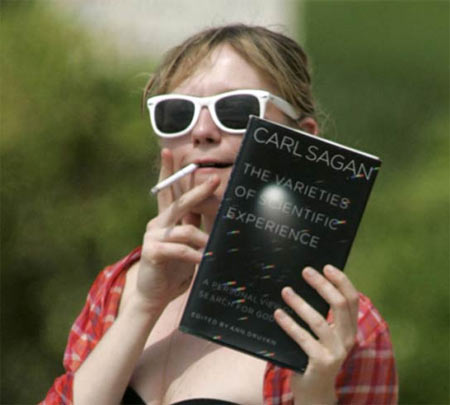
On a personal note, I have now read almost every Sagan work of popular non-fiction. All that's left is to borrow Kirsten Dunst's copy of "The Varieties of Scientific Experience"
Subscribe to:
Posts (Atom)